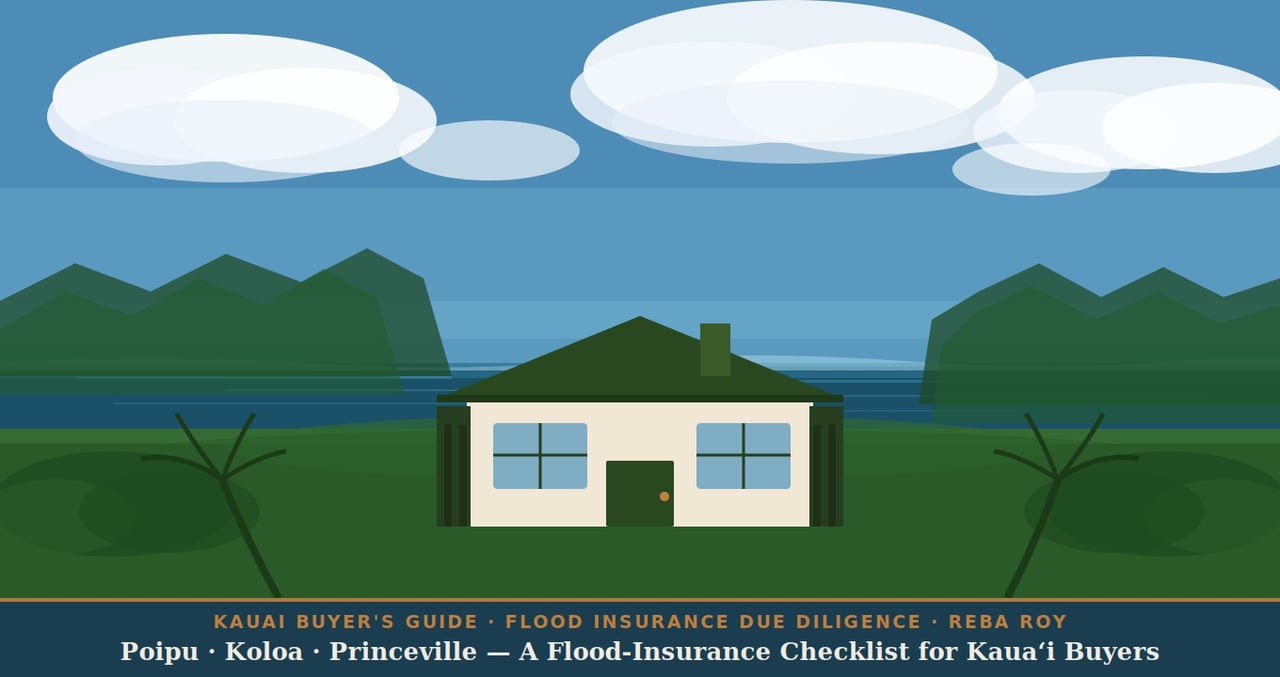
Kauaʻi Buyer's Guide · Flood Insurance Due Diligence
Flood risk on Kauaʻi is property-specific. Two homes in the same neighborhood can have different elevations, drainage conditions, and insurance costs. Here's what to sort out during due diligence — not the week before closing.
Buying a home on Kauaʻi means looking at more than the view, the condition of the property, or how close you are to the beach. Water deserves its own due diligence.
That does not mean every coastal property carries the same flood exposure, or that a property outside a high-risk flood zone should automatically be treated as safe. On Kauaʻi, the questions can change considerably from one property to the next — based on elevation, drainage, nearby streams, terrain, coastal exposure, and how water moves through the area during heavy rain.
For buyers in Poipu, Koloa, Princeville, and elsewhere on the island, these are questions worth sorting out while we are evaluating the property, not when the lender or insurance company is trying to clear the file for closing.
Start With the Flood Map
The first place to look is the flood-zone information for the property. Kauaʻi County directs buyers to the State of Hawaiʻi Flood Hazard Assessment Tool — FHAT — which displays FEMA's current flood-zone mapping.
That information is useful — but it does not tell us everything about an individual property. The state's own mapping guidance notes that FEMA flood zones do not identify every location where flooding can occur. Local drainage, topography, rainfall, and surrounding conditions can still matter even outside a Special Flood Hazard Area.
Special Flood Hazard Areas. Flood insurance typically required when federally backed mortgage applies.
Moderate to low risk. Insurance not usually required — but flooding can still occur.
Outside mapped Special Flood Hazard Area. Lower risk does not mean no risk — especially on Kauaʻi.
Look Beyond the Flood-Zone Letter
When evaluating a Kauaʻi property, I also want to understand how the site itself handles water. That may mean reviewing seller disclosures for any history of flooding or water intrusion, asking whether elevation information is available, and paying attention to drainage improvements, nearby streams, low areas, slopes, culverts, retaining walls, or other conditions that could affect how water moves around the property.
"The useful question is not simply 'Is this house in a flood zone?' It is: 'What do we know about this particular property, and is there anything else we should investigate before we move forward?'"
A home near the coast in Poipu may raise a different set of questions than a property farther inland in Koloa. On the North Shore, terrain, streams, drainage, and heavy rainfall each deserve closer attention — as the recent storms have reminded us. Those details can matter even when a home is not in one of FEMA's highest-risk zones.
Coastal Properties — Additional Layer
For properties near the shoreline, there may also be separate shoreline and land-use questions to investigate — including Kauaʻi's shoreline setback regulations, which were updated in 2026. Shoreline rules and flood insurance are different issues, but both are examples of why parcel-specific due diligence matters on Kauaʻi.
Find Out What the Lender Requires
Flood insurance may also become a financing issue. When a building is located in a FEMA Special Flood Hazard Area and the mortgage falls under applicable federal requirements, flood insurance generally must be maintained. A lender may also have its own requirements depending on the property and the loan structure.
This is a conversation worth having with your lender early — ideally before you are deep into escrow. If coverage or additional documentation will be required, it is much easier to deal with while there is still time to compare options and make deliberate decisions.
Even when flood insurance is not required by the lender, understanding the property's flood exposure and the cost of coverage before closing is simply good due diligence.
Compare the Coverage Available
Two sources of flood coverage are worth understanding for any Kauaʻi property under consideration.
- Federally backed
- Available in most communities including Kauaʻi
- Standardized coverage structure
- Separate policies for building and contents
- May satisfy lender requirements
- Offered by private insurers
- May provide different coverage limits
- Potentially different premiums and deductibles
- Coverage structure varies by insurer
- May or may not satisfy lender requirements
There is no reason to assume in advance that one will always be the better fit. The meaningful comparison is the actual coverage available for the specific home being purchased: premium, deductible, building and contents limits, important exclusions, effective date, and whether the policy satisfies the lender.
Kauaʻi Buyer Flood-Insurance Checklist
Before finishing your due diligence on a home in Poipu, Koloa, Princeville, or elsewhere on Kauaʻi, make sure you can answer each of these:
What FEMA flood zone is the building in?
Have I reviewed the property using Hawaiʻi's Flood Hazard Assessment Tool (FHAT)?
Is there an Elevation Certificate or other elevation information available?
Has the seller disclosed any previous flooding or water intrusion?
Are there drainage issues or features on or near the property worth investigating?
Are there streams, slopes, low areas, or surrounding conditions that could affect drainage during heavy rain?
Does my lender require flood insurance for this property?
If coverage is not required, do I still want a quote to understand the cost and exposure?
Have I compared NFIP and private flood-insurance options where available?
Does the policy meet my lender's requirements?
Do I understand the deductible, coverage limits, contents coverage, and important exclusions?
Will the coverage be effective when I need it?
Have I resolved these questions early enough that they will not interfere with financing or closing?
One Property at a Time
Kauaʻi real estate is highly property-specific. Two homes in the same general area can have different elevations, drainage conditions, flood-zone designations, insurance costs, and lender requirements. That is why I look at the actual property rather than make assumptions based solely on the neighborhood or the flood-zone label.
Part of my job as your broker is knowing when something deserves a closer look — and making sure you have the right information and the right people involved before you make a decision. On Kauaʻi, flood risk and insurance are simply another part of doing that due diligence well.
Questions About a Kauaʻi Property?
Whether you're evaluating a home in Poipu, Koloa, Princeville, or anywhere else on the island, I'm glad to walk through the due-diligence process with you — including flood-zone review, seller disclosures, and connecting you with the right resources for insurance and financing questions.
Warm Aloha,
Reba Roy, REALTOR® · RB-23783
Corcoran Pacific Properties · Kauaʻi & the Hawaiian Islands