Kauai Real Estate · Property Owner Alert
A Honolulu retiree is fighting to keep her home after a rental platform error triggered nearly $600,000 in fines. The legal framework behind that penalty exists across Hawaii — including here on Kauai.
Her name is Sandra May. She is 83 years old, has lived in her Honolulu home since the late 1960s, and relies on a small attached rental unit for supplemental income. She has no interest in operating a vacation rental. She never intended to.
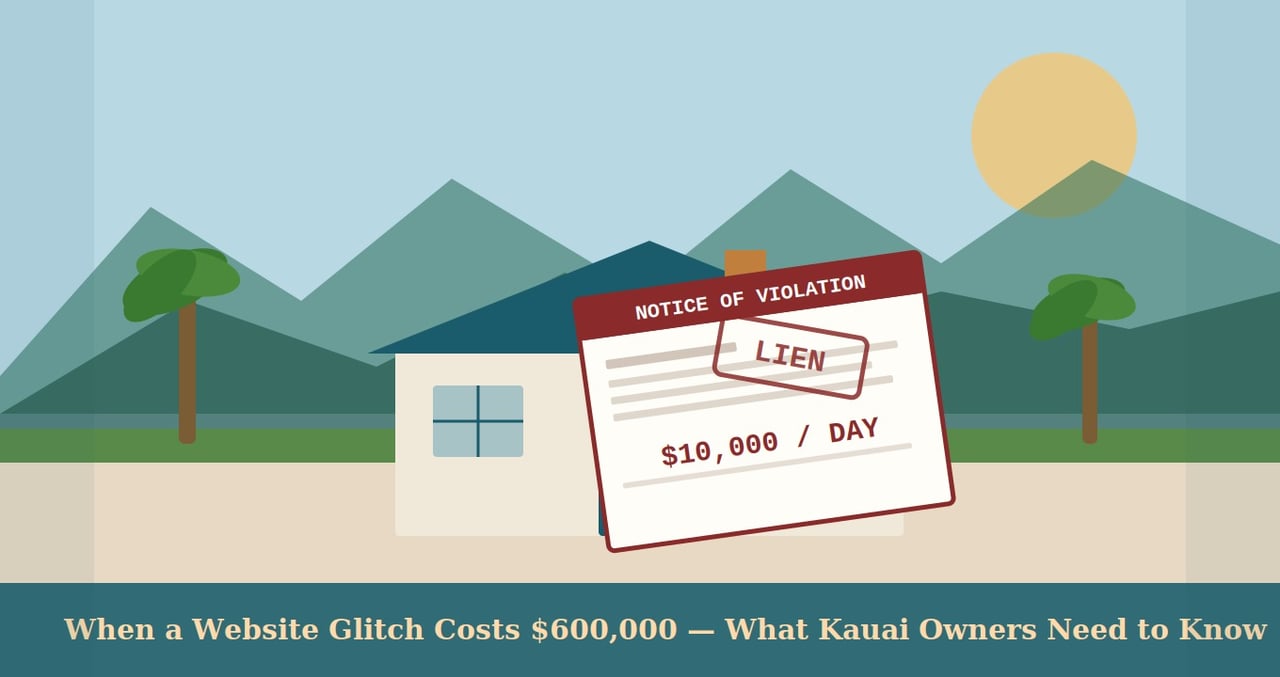
But in 2025, she found herself facing a government demand for over $600,000 — the result of an online rental platform error that briefly allowed users to view her property as available for short-term stays while she was hospitalized recovering from a car accident.
No short-term stays were ever booked. No guests arrived. The platform itself confirmed it was a system error. Sandra had configured the listing for stays of 30 days or more.
None of that stopped the city from acting.
Filed May 28, 2026 in U.S. District Court. Represented pro bono by the Pacific Legal Foundation.
After a rental platform glitch allowed short-term availability inquiries — not bookings — on her listing, Honolulu assessed fines of $10,000 per day for approximately two months. Total: over $600,000.
The city placed a lien on her home and banned her from all city services, including driver's license renewal and vehicle registration.
Her lawsuit argues the fines violate the Eighth Amendment's prohibition on excessive government penalties — constitutionally disproportionate to an accidental advertisement for a rental that never occurred.
"The City and County of Honolulu are using this ordinance as a revenue-generating scheme and violating property owners' constitutional rights." — Loren Seehase, Pacific Legal Foundation
This Isn't an Isolated Case
Honolulu's enforcement framework has generated more than $90 million in fines for similar advertising violations — fines assessed not for illegal rentals, but for illegal advertisements. Under current ordinance, a property owner can be fined $10,000 per day simply for a listing that shows a property as available for fewer than 30 consecutive days, regardless of whether any short-term booking was ever made or attempted.
"Governments cannot simply impose fines that are so ruinous that they would financially devastate someone over a simple error. That's what we're fighting for."
— Attorney Loren Seehase, Pacific Legal Foundation
The broader pattern across Hawaii is worth understanding. Counties throughout the state are tightening short-term rental regulations, expanding enforcement infrastructure, and increasing fine structures — in some cases writing penalties into law before the systems to comply with them even exist.
What This Means on Kauai
Kauai's regulatory environment is among the most restrictive in the state — and in some respects, more unforgiving than Oʻahu's.
A moratorium on new residential Transient Vacation Unit (TVU) permits has been in place since 2008. Resort-zoned properties in areas like Princeville and Poipu represent the primary remaining investor pathway for legal short-term rental operations. Owners outside those zones operate legally only if they hold one of a limited number of existing grandfathered permits.
For those who do hold permits, the stakes around compliance are significant.
Under Kauai's Ordinance 950, missing your annual TVU permit renewal deadline by even one business day results in permanent forfeiture of your permit.
There is no grace period. There is no appeal path. There is no option to reapply. The county sends no reminders.
A permit held for decades — representing significant property value — can be extinguished by a calendar oversight.
Fines for non-permitted STR operation on Kauai can reach $10,000 per day.
Kauai County has also indicated plans to expand digital tracking systems that integrate directly with platforms like Airbnb and VRBO — making it easier to identify unpermitted operations and initiate enforcement actions, including in cases of listing errors.
The Legal Question Sandra May Is Raising
The constitutional argument at the center of the Honolulu case deserves attention beyond that city. The Eighth Amendment prohibits the government from imposing fines that are grossly disproportionate to the underlying offense. A $600,000 penalty for an accidental online listing that produced no bookings and caused no demonstrable harm is precisely the kind of government overreach that clause was designed to address.
If the Pacific Legal Foundation prevails, it could affect how fine structures across Hawaii counties are evaluated — including Kauai's. But that outcome is not guaranteed, and it will take time to resolve. In the meantime, the enforcement framework is active.
What the case already illustrates, regardless of its outcome: these fines are real, they accumulate quickly, and the enforcement posture of Hawaii counties has become increasingly aggressive.
What Property Owners Should Do Now
Whether you currently hold a TVU permit, rent long-term, or are simply considering your options for a property with rental history, a few things are worth confirming:
Know your permit status precisely. If you hold a Kauai TVU permit, verify your renewal date and build a calendar reminder well in advance. Given Ordinance 950's zero-tolerance standard, treating this like a routine renewal is not an option.
Audit your online listings. Review every platform where your property appears — including listings you set up years ago and may not have revisited. Platform errors happen. Confirm that every listing accurately reflects your actual rental structure, including minimum stay requirements.
Understand your zoning.strong> Know definitively whether your property is resort-zoned, residential, or something else — and what STR activity, if any, is permitted. If you're uncertain, that uncertainty itself is a risk.
Consult a real estate professional before making any rental changes. In this regulatory environment, a listing update or platform adjustment that seems minor can have significant consequences if it's read as a violation.
Sandra May's case is drawing national attention — and rightly so. It raises legitimate questions about proportionality, due process, and the limits of government enforcement power. But for Kauai property owners right now, the practical lesson isn't to wait for a court ruling.
It's to know exactly where you stand — before a platform glitch, a missed renewal, or an unreviewed listing creates a situation you didn't see coming.
Questions About Your Kauai Property's Rental Status?
Whether you're navigating an existing TVU permit, evaluating a property with rental history, or simply trying to understand how current regulations affect your ownership position, I'm available to walk through it with you clearly — no pressure, just good information.
Understanding your property's status in today's regulatory environment is part of making sound decisions about what to hold, what to list, and when to sell.
"If you own property on the South Shore and have questions about your rental status or how current regulations affect your options, I'm glad to help you understand where you stand."