Luxury Market Report · Kauaʻi & Hawaii · September 2026
Luxury real estate is not one market — it's many. The national picture, Hawaii's county-by-county reality, and what the numbers mean specifically for buyers and sellers on Kauaʻi right now.
As we move into fall 2026, one message is coming through clearly across the luxury real estate landscape: where a property is located, what condition it's in, and how it's priced matters more than ever. Buyers have access to more information and more choices than at any point in recent memory — and they're using both.
Here's what the data is showing at each level, and what it means on the ground in Kauaʻi.
National Luxury Market — A Shift Worth Watching
August may have marked the beginning of a subtle but meaningful shift in the North American luxury market. After much of 2026 was characterized by stronger sales and tight inventory, new listings began returning. The numbers are instructive.
That combination — rising sales, rising prices, and sharply falling days on market — tells us that qualified luxury buyers are still willing to act decisively when the right property appears. What has changed is the standard. Today's affluent buyer is focused on quality, location, condition, and long-term value. Simply being available isn't enough.
The attached-home market was more measured: sales declined 4.3% year over year, though inventory was also 4.2% lower. Prices held essentially flat. The headline numbers don't tell the whole story — and that's exactly the point.
What Luxury Buyers Want in 2026
Affluent buyers today have choices — and that is reshaping which properties receive serious attention.
That last point has particular relevance for Hawaii. Luxury purchasers are increasingly less interested in taking on extensive renovations or complicated construction projects after closing. They want to arrive and live — whether in a primary residence, a second home, an investment property, or an island retreat. In our market, buyers aren't simply purchasing square footage. They're purchasing a lifestyle.
Hawaii — One State, Four Very Different Markets
The August data illustrates just how different Hawaii's four counties can be at the same moment in time.
County | Sales Ratio | Classification |
|---|---|---|
Oʻahu | 15.4% | Balanced |
Hawaiʻi Island | 8.4% | Buyer's Market |
Maui | 8.1% | Buyer's Market |
Kauaʻi | 6.3% | Buyer's Market |
This is exactly why buyers and sellers should be cautious about applying a national — or even statewide — headline to a specific Hawaii property. Oʻahu's balanced luxury market looks nothing like Kauaʻi's current conditions. And within Kauaʻi itself, the picture varies further still.
Kauaʻi Luxury Market — The Specifics
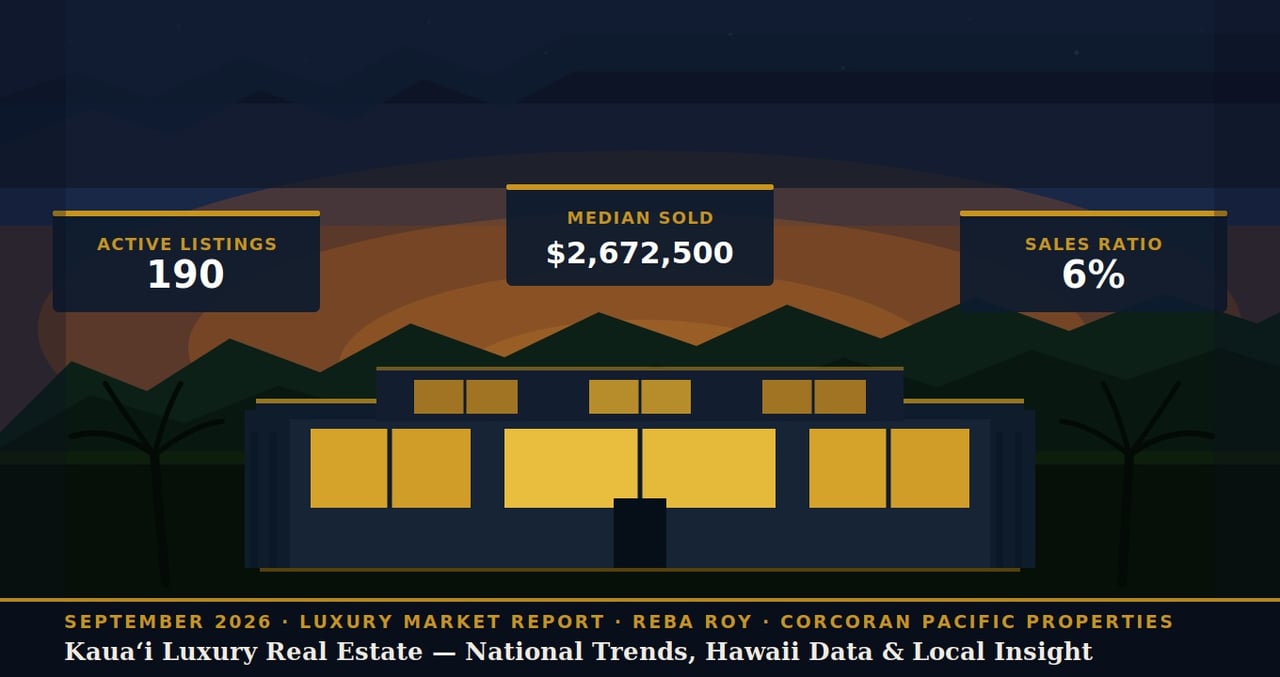
The luxury benchmark for single-family homes on Kauaʻi in this report is $1.2 million — meaning the figures below reflect all homes priced above that threshold.
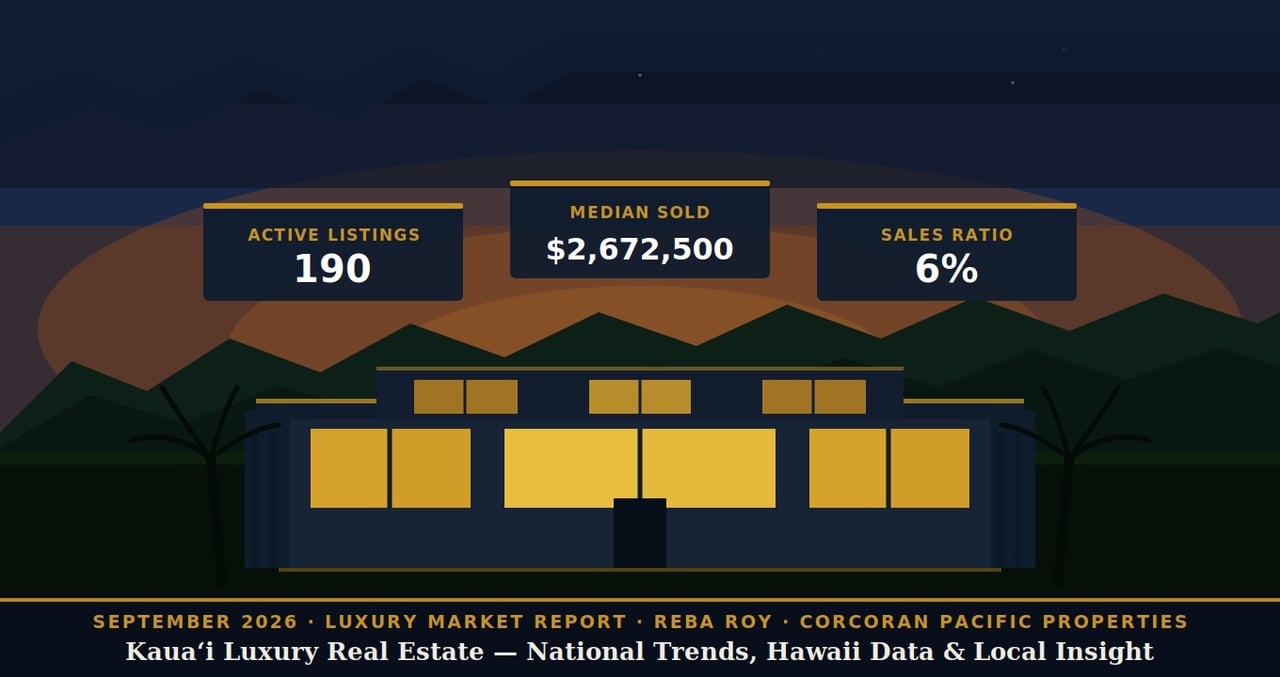
A 6% sales ratio with 190 homes in inventory and 12 closings places Kauaʻi in buyer's market territory. But that number is a starting point, not a conclusion.
"A well-positioned home in Poʻipū, Kōloa, Kukuiʻula, or Princeville can behave very differently from the island-wide statistics. Condition, views, vacation-rental potential, amenities, location, and pricing all influence buyer demand — and some of those variables matter more here than they do almost anywhere else."
This mirrors what we're seeing nationally: simply putting a luxury property on the market isn't enough. The differentiators — location, condition, design, lifestyle amenities, and pricing — determine whether a property moves in weeks or sits for months.
What This Means for Buyers and Sellers on Kauaʻi
- Buyers are comparing your property against 190 competing listings — and against luxury options on other islands
- Pricing in line with current conditions is not a concession; it's a strategy
- Overpricing is especially costly when buyers have real alternatives
- Professional presentation, condition, and lifestyle positioning are genuine differentiators right now
- The goal is to make qualified buyers recognize your property's value the moment they see it
- 190 active listings means genuine choice — more time to evaluate, more room to compare
- Depending on the listing, there may be more negotiating room than during tighter periods
- Exceptional properties in top locations still attract attention quickly — preparation matters
- Understand neighborhood-level conditions, recent comparable sales, and property competition before deciding how to offer
- Kauaʻi's current conditions are among the most buyer-favorable in Hawaii
Looking Ahead
Inventory levels, interest rates, and broader economic conditions will remain important factors through the fall. If sellers continue returning to the market while sales hold steady, the luxury segment could move toward greater balance. But rising inventory alone does not shift conditions decisively in buyers' favor — motivated sellers and exceptional properties still find buyers.
The most important takeaway for Kauaʻi may be the simplest one: real estate is local, and luxury real estate is even more specific. National trends provide useful context. Hawaii statistics show us the range. But determining the value and strategy for an individual Kauaʻi property requires looking closely at its community, location, condition, competition, and the buyers active in that specific segment right now.
Thinking About Buying or Selling on Kauaʻi?
For a detailed analysis of your property or the Kauaʻi community you're considering, I'm glad to walk through current market conditions and a personalized strategy with you. Every property and every situation is different — and that's exactly where local knowledge matters most.
Warm Aloha,
Reba Roy, Broker · Corcoran Pacific Properties
Kauaʻi & the Hawaiian Islands
Market statistics are based on the September 2026 Luxury Market Report from The Institute for Luxury Home Marketing. The report uses luxury benchmark prices established by the Institute and data compiled from multiple sources. Data is deemed reliable but is not guaranteed. Sales ratio figures are for luxury single-family homes as defined by the Institute's methodology.