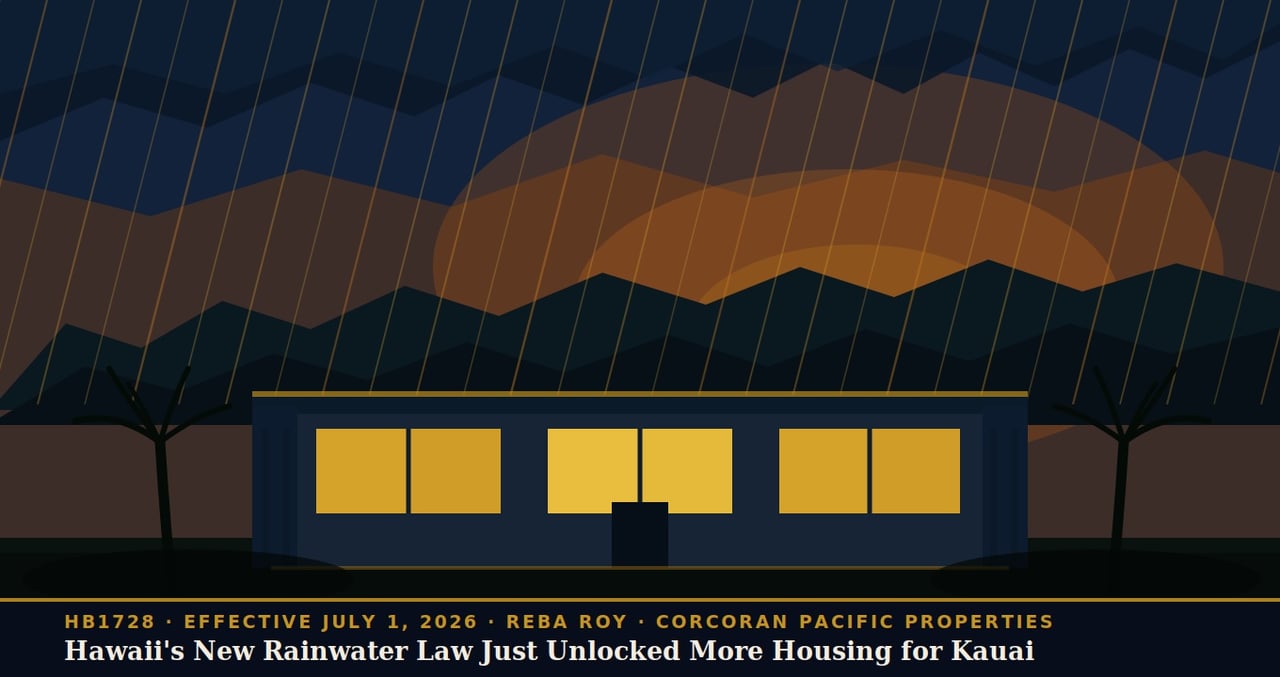
A quiet but significant change took effect July 1. For Kauai property owners who couldn't build additional units because of water access limits — that barrier is now gone.
There's a specific kind of frustration that comes with wanting to do the right thing — build housing, add a backyard cottage, create workforce units for employees — and being told you can't. Not because of zoning. Not because of budget. Because there's no water connection available, and the rules won't let you supply your own.
That was the reality for many Kauai property owners. And as of July 1, 2026, it changed.
Allows property owners across Hawaii to install rainwater catchment systems on any property — including those already served by county water lines. Supersedes county regulations that previously prohibited catchment in areas with existing water access.
Why This Matters on Kauai
Kauai's Department of Water had a rule that prevented rainwater catchment systems anywhere the county water system already served — even in areas where that system was operating at maximum capacity. The result was a catch-22: you couldn't tap into an at-capacity county line, and you couldn't supply your own water either.
That restriction quietly blocked a meaningful amount of potential housing. Backyard cottages. Farm dwellings. Affordable rental units. Additional living spaces for ʻohana. Not because of planning rules or permit costs — but because the water equation didn't have a solution.
HB1728 solves the equation.
— The Garden Island, July 16, 2026
A Real Project — Stopped by This Exact Barrier
The impact isn't abstract. The Waipā Foundation has spent years planning employee housing on the approximately 1,600 acres it manages near Hanalei — housing that would support the community and economic development work at the heart of its mission.
The project stalled not from lack of commitment or resources, but because the Hanalei county water system had no capacity to serve the new units — and prior rules prohibited the foundation from installing an independent catchment system as an alternative.
"The Kauaʻi Department of Water has informed us that the Hanalei system does not have capacity to support our project, and regulations do not currently permit another potable water system on a property with an existing county meter." — Stacy Sproat, Executive Director, Waipā Foundation, testimony to state senators, April 2026
Her conclusion at the time: without a change in the rules, the project was "dead in the water." HB1728 is that change.
The Broader Housing Opportunity
The Waipā Foundation's situation isn't unique — it's representative. Across Kauai, properties in rural areas, agricultural zones, and communities served by aging or at-capacity water infrastructure have faced the same wall. HB1728 opens a path that simply didn't exist before July 1.
Backyard Cottages & ADUs
Property owners who couldn't add a dwelling unit due to water access limits now have a viable supply alternative.
Farm Dwellings
Agricultural properties in areas with limited or at-capacity county water can now build worker and owner housing.
Workforce & Employee Housing
Organizations like Waipā Foundation — and private employers — can move forward with housing projects previously blocked by water rules.
Rural & Underserved Areas
Communities where county infrastructure doesn't reach or has no remaining capacity gain new residential development potential.
Supply and Affordability — Why This Connects
More housing supply doesn't just help the people who move into new units. It creates movement throughout the market — freeing up existing homes, expanding rental availability, and reducing the demand pressure that drives prices up.
On Kauai, where land constraints are real and infrastructure has historically limited what can be built, every removed barrier matters. HB1728 is a supply-side win that operates at the neighborhood and parcel level — exactly where housing shortages are felt most acutely.
I've been a supporter of expanding affordable housing options on Kauai for a long time. Not because it changes the value of existing properties — Kauai's market fundamentals are durable — but because a community where people who work here can afford to live here is a stronger community. That's good for everyone.
One Important Caveat — Rainfall
Rainwater catchment depends on rain. Kauai experienced 85% less rainfall in 2025 than its historical average — a reminder that drought conditions are becoming more frequent, and that catchment systems are not equally viable across all properties or all climate scenarios.
The state Department of Land and Natural Resources notes that alternative water sources including catchment "help address the concern that current and future droughts could deplete stream and well water resources" — framing catchment as part of a diversified water strategy, not a guaranteed standalone solution.
Any property owner considering a catchment-dependent build should factor in local rainfall history, storage capacity, and drought risk as part of the planning process.
What Farmers and the State Are Saying
Support for the bill extended well beyond housing advocates. Hunter Heaivilin, advocacy director for Hawaiʻi Farmers Union United, testified in favor, noting that allowing catchment for both potable and nonpotable uses "empowers farmers and residents alike to harness an abundant and renewable resource."
The state Department of Land and Natural Resources' Commission on Water Resource Management also supported the measure, encouraging the use of alternative water sources — including rainwater catchment — as a way to reduce pressure on stream and well water during drought periods.
That alignment — housing advocates, farmers, and environmental managers all pointing in the same direction — is unusual and meaningful. It suggests HB1728 addresses a real structural need, not a narrow constituency.
For Kauai property owners who have been waiting on a build because the water question had no good answer — it's worth revisiting that conversation. The rules just changed in a meaningful way.
Questions About What This Means for Your Property?
If you've been thinking about adding a dwelling unit, building on a rural parcel, or exploring what's possible on a property with limited county water access — I'm glad to walk through the current landscape with you. Understanding what's changed, and how it interacts with Kauai's zoning and permitting environment, is where I can help.
Warm Aloha,
Reba Roy, REALTOR®
Corcoran Pacific Properties · RB-23783
Serving Kauai & the Hawaiian Islands