Voter Education · Hawaiʻi 2026 Ballot · Reba Roy
A constitutional amendment on this fall's ballot would give Hawaiʻi counties a new tool to finance housing infrastructure. Here's what it would actually do, how the financing works, and why the voting rules mean you shouldn't leave it blank.
When Hawaiʻi voters receive their ballots this fall, there is an important question near the end that deserves attention.
It is Question 2 — concerning Resilient Infrastructure for Shelter and Equity, commonly called RISE bonds.
The wording is technical, but the underlying issue is straightforward: How can Hawaiʻi communities pay for the roads, water, sewer, and other infrastructure needed to support new housing? Regardless of how you ultimately vote, understanding what Question 2 would actually do is worthwhile.
The ballot question asks whether Hawaiʻi's Constitution should be amended to direct the Legislature to authorize counties to issue RISE bonds to fund public improvements within designated districts.
Under the proposal, those bonds would be repaid from future growth in property-tax revenue generated within those districts — not by increasing real-property-tax rates. The bonds would be excluded from normal county debt limits and subject to accountability and oversight requirements established by law.
Read the official ballot language → Hawaii Office of Elections
Why Infrastructure Matters to Housing
We often talk about Hawaiʻi's housing shortage as though the solution is simply to build more homes. It isn't that simple.
Before many homes can be built, communities need infrastructure: water systems, wastewater and sewer capacity, drainage, roads, utilities, and other public improvements. The Legislature's committee report on the RISE proposal specifically identified water, wastewater, drainage, roads, and sea-level-rise mitigation among the infrastructure needs associated with housing development — and concluded that existing funding mechanisms were not sufficient to meet the scale and timing of those needs.
That is particularly relevant on islands like Kauaʻi, where infrastructure capacity can determine where and how future housing and community development is possible.
How RISE Financing Would Work
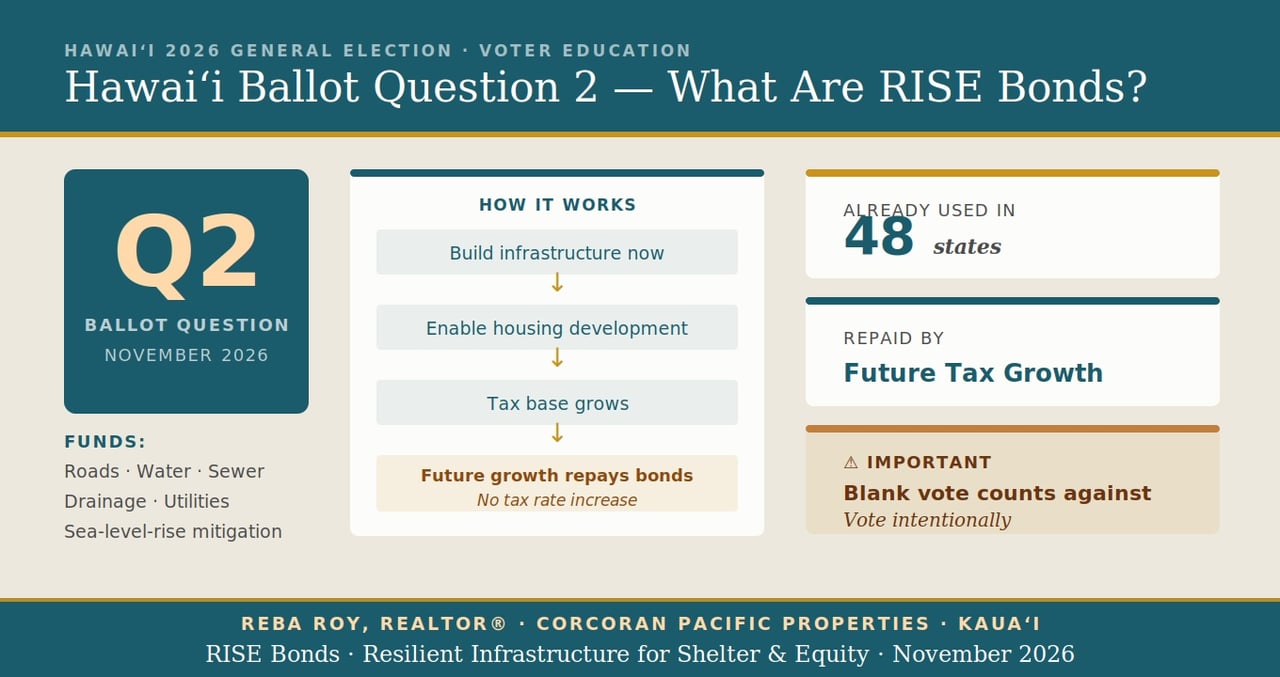
The basic concept is called value-capture financing — sometimes known as tax-increment financing. Here's the sequence:
A county designates a district where infrastructure improvements are needed to enable housing or community development.
RISE bonds are issued to finance the public infrastructure — roads, water, sewer, drainage — needed within that district.
The infrastructure enables development. As new homes and properties are built, the tax base within the district grows.
A portion of the future increase in property-tax revenue — not an increase in tax rates — repays the bonds that financed the infrastructure that made that growth possible.
"Build needed infrastructure now → enable development → development expands the tax base → a portion of that future revenue growth pays for the infrastructure. Existing property owners' tax rates are not increased."
Hawaiʻi Is an Outlier on This
Materials submitted to the Legislature and the General Contractors Association of Hawaiʻi both describe this financing mechanism as authorized in 48 states. That doesn't mean every state's program works exactly the same way — each state establishes its own rules, safeguards, and oversight structures.
But it does mean the underlying concept is not new, untested, or experimental. Hawaiʻi is among the very few states where counties have not had access to this tool.
Why a Constitutional Amendment Is Required
Hawaiʻi's Constitution places limitations on county debt. The proposed amendment would expressly authorize the Legislature to allow counties to issue RISE bonds, and would exclude qualifying RISE debt from counties' normal funded-debt calculations.
That is why this cannot simply be done through a county ordinance or state legislation alone. Voters must first decide whether to change the State Constitution to provide this authority — which is why it appears on your ballot.
What Supporters and Critics Say
Supporters — including the state, counties, planners, developers, and the construction industry — say RISE would let infrastructure be built ahead of housing without raising rates on existing owners. They argue this lowers the up-front costs that get passed on to buyers.
Critics: The Tax Foundation of Hawaiʻi has argued the amendment isn't needed because a state law allowing this type of financing has been on the books for decades.
Hawaiʻi's Attorney General has concluded that the State Constitution doesn't specifically allow these bonds — meaning counties can't safely issue them under the existing law alone. That legal uncertainty is why the tool has gone unused for decades. Counties face exposure to legal challenge if they try to issue bonds without clear constitutional authority.
The amendment would resolve that uncertainty. The Tax Foundation's objection doesn't settle the question — it's answered by the AG's own position on what the Constitution currently allows.
The details of how districts are chosen, which projects qualify, and what safeguards apply would be set by future law.
Questions Worth Considering
Giving counties another financing tool does not mean every proposed RISE project would automatically be a good one. Voters may reasonably want to understand how districts will be selected, what projects qualify, how much future property-tax growth can be committed, what safeguards will apply, and how taxpayers would be protected if anticipated development does not occur as projected.
The ballot proposal expressly anticipates accountability and oversight requirements established by law. Both the opportunity and the responsibility that comes with this financing authority matter.
⚠ Don't Leave Question 2 Blank
Hawaiʻi's rules for approving constitutional amendments are unusual. According to the Hawaiʻi Office of Elections, an amendment must receive a majority of votes tallied after blank and overvotes are excluded and affirmative votes must also equal at least 50% of all votes cast — including blank and overvotes.
In practical terms: leaving Question 2 blank makes it harder for the amendment to reach the required threshold. It is not a neutral act.
Whatever your position, read the question, make an intentional choice, and vote it. Don't overlook it.
Learn More Before You Vote
Official
Hawaiʻi Office of Elections — Official Question 2 Information
The state's official ballot language and explanation of the proposed constitutional amendment.
Legislative
Hawaiʻi Legislature — Committee Report on the RISE Proposal
The legislative background, reasoning, and infrastructure needs identified by the committee that advanced the proposal.
Advocacy
An organization advocating for passage of the amendment. This is a campaign source, not a neutral government resource — view it in that context.
My Perspective
As a REALTOR® who works every day with people trying to make a life in Hawaiʻi, I believe we need a serious and honest conversation about the connection between housing and infrastructure.
We cannot simply say that Hawaiʻi needs more housing without addressing the water, sewer, roads, and other infrastructure necessary to support it. Question 2 asks voters whether our counties should have access to another financing mechanism to address that challenge — one already used in 48 other states.
I encourage you to read the information, ask questions, understand both the benefits and the safeguards, and then make the decision you believe is right for Hawaiʻi. The most important thing is that you make an informed, intentional choice.
Questions About Kauaʻi Real Estate?
Ballot measures like Question 2 connect directly to the future of housing on Kauaʻi — from infrastructure capacity to where new homes can be built. If you have questions about how current conditions or future development might affect your property or your home search, I'm glad to talk through it.
Warm Aloha,
Reba Roy, REALTOR® · RB-23783
Corcoran Pacific Properties · Kauaʻi & the Hawaiian Islands
This post is provided for voter-education purposes only. It is not intended as political advocacy for or against any ballot measure. Links to third-party sources are provided for reference; readers should consult official government sources for authoritative information. Real estate advice is specific to individual property and market conditions — contact Reba Roy directly for a personalized consultation.